What COVID-19 Sounds actually does (from store listing)
This app is part of a research project at the University of Cambridge. The aim of this research is to develop machine learning algorithms to automatically detect if a person is suffering of COVID-19, based primarily on sounds of their voice, their breathing and coughing.
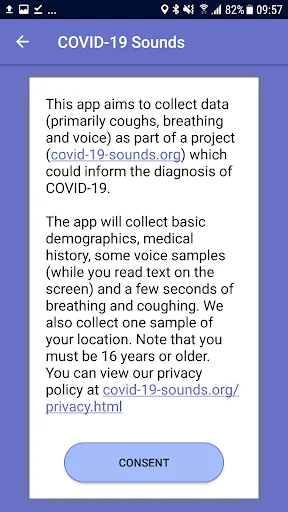
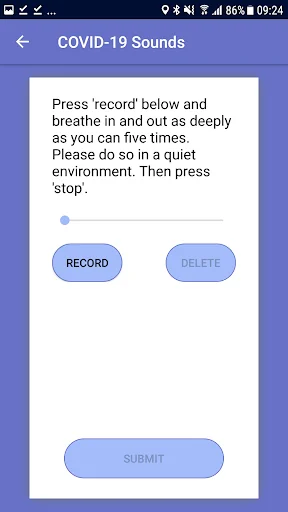
In order to enable this research we are launching a large scale, crowdsourced data collection through a mobile app. The app will collect some basic demographics and medical history data, as well as some voice samples (while …
This app is part of a research project at the University of Cambridge. The aim of this research is to develop machine learning algorithms to automatically detect if a person is suffering of COVID-19, based primarily on sounds of their voice, their breathing and coughing.
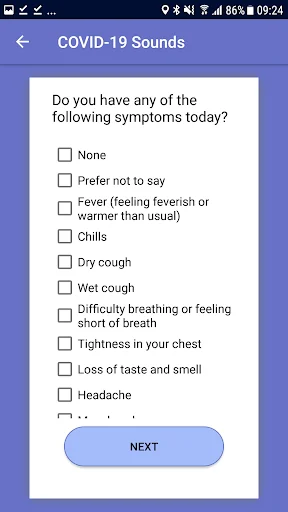
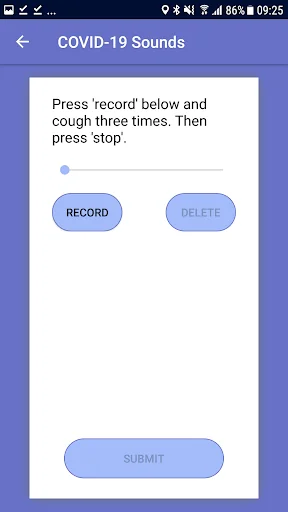
In order to enable this research we are launching a large scale, crowdsourced data collection through a mobile app. The app will collect some basic demographics and medical history data, as well as some voice samples (while you read text on the screen) through a questionnaire and a few seconds of breathing and coughing through the phone microphone. We will additionally collect one location sample. The app will also ask if you have tested positive for the virus. The app won't be tracking you and only collect this data when you actively interact with it.
The data will be stored on University servers and be used solely for research purposes. We hope to release the dataset we are collecting to other researchers after the initial analysis.
The app will not give medical advice and any reports of symptoms will not be responded to by medical assistance.
This app is available in English, Spanish, French, German, Hindi, Greek, Portuguese, Russian, Italian, and Chinese.
Comparable Android apps
The five apps in Education with the closest revenue to COVID-19 Sounds. Click any to see its detail page.
Each forecast combines App Store rating, ratings count, monetisation model, pricing tier, IAP signals and ad-supported flag.
The base estimate is then multiplied by a per-category scaling factor learned from apps with founder-verified MRR.
Every number on this page comes from public APIs and bumetric's own snapshot history.
Full methodology covers input variables, accuracy bands per category and how we treat apps without comparable anchors.
See also the live data on COVID-19 Sounds's tracker page for current rating, reviews and snapshot timeline.
Building something similar? Get a free AI audit with $-revenue forecasts for every recommendation.
 RockCheck
 MSBTE COMET
 Biotechnology Dictionary
 Kids Song Collection 1
 संविदा शिक्षक | परीक्षा