What Virtual Harmonica actually does (from store listing)
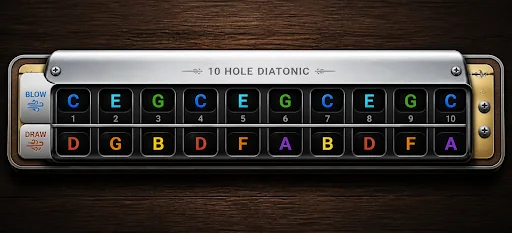
The harmonica, also known as a French harp or mouth organ, is a free reed wind instrument used worldwide in many musical genres, notably in blues, American folk music, classical music, jazz, country, and rock. The many types of harmonica include diatonic, chromatic, tremolo, octave, orchestral, and bass versions. A harmonica is played by using the mouth (lips and tongue) to direct air into or out of one (or more) holes along a mouthpiece. Behind each hole is a chamber containing at least one ree…
The harmonica, also known as a French harp or mouth organ, is a free reed wind instrument used worldwide in many musical genres, notably in blues, American folk music, classical music, jazz, country, and rock. The many types of harmonica include diatonic, chromatic, tremolo, octave, orchestral, and bass versions. A harmonica is played by using the mouth (lips and tongue) to direct air into or out of one (or more) holes along a mouthpiece. Behind each hole is a chamber containing at least one reed. The most common is the diatonic Richter-tuned with ten air passages and twenty reeds, often called the blues harp. A harmonica reed is a flat, elongated spring typically made of brass, stainless steel, or bronze, which is secured at one end over a slot that serves as an airway. When the free end is made to vibrate by the player's air, it alternately blocks and unblocks the airway to produce sound.
Reeds are tuned to individual pitches. Tuning may involve changing a reed’s length, the weight near its free end, or the stiffness near its fixed end. Longer, heavier, and springier reeds produce deeper, lower sounds; shorter, lighter, and stiffer reeds make higher-pitched sounds. If, as on most modern harmonicas, a reed is affixed above or below its slot rather than in the plane of the slot, it responds more easily to air flowing in the direction that initially would push it into the slot, i.e., as a closing reed. This difference in response to air direction makes it possible to include both a blow reed and a draw reed in the same air chamber and to play them separately without relying on flaps of plastic or leather (valves, wind-savers) to block the nonplaying reed.
Comparable Android apps
The five apps in Music with the closest revenue to Virtual Harmonica. Click any to see its detail page.
Each forecast combines App Store rating, ratings count, monetisation model, pricing tier, IAP signals and ad-supported flag.
The base estimate is then multiplied by a per-category scaling factor learned from apps with founder-verified MRR.
Every number on this page comes from public APIs and Bumetric's own snapshot history.
Full methodology covers input variables, accuracy bands per category and how we treat apps without comparable anchors.
See also the live data on Virtual Harmonica's tracker page for current rating, reviews and snapshot timeline.
Building something similar? Get a free AI audit with $-revenue forecasts for every recommendation.




 Liminality
 Kids Music Instruments - Learn
 Mukiz - Guess the song
 Toddlers Saxophone
 Play Piano: Melodies | Notes