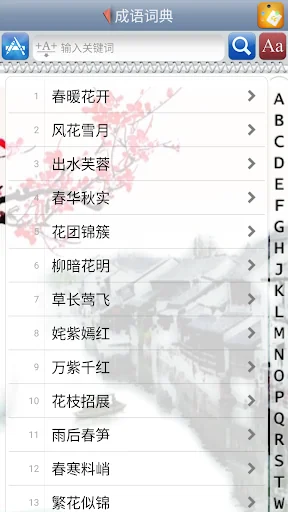
Idiom Dictionary is a practical reference software for checking comprehensive information of idiom entries on the Android platform. It contains more than 34,000 idiom entries in total.
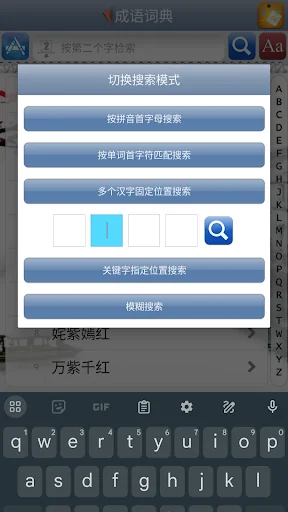
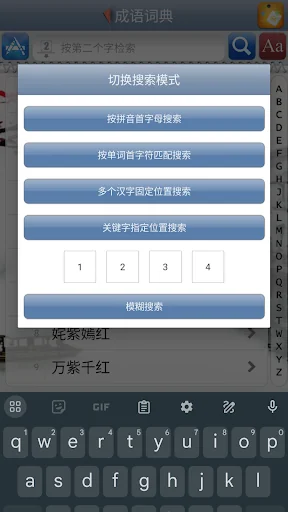
The original multi-functional search method supports: fuzzy, first word matching, customized position, pinyin code and special glyph search.
Supports numerous idiom categories:
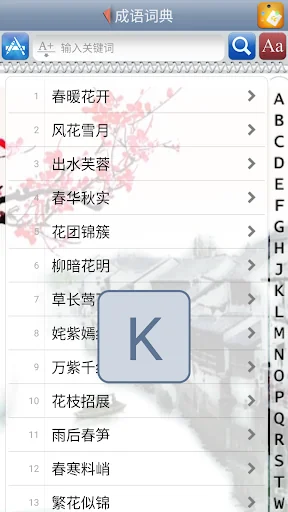
Search by first letter;
Search by situational classification, such as idioms describing preciousness, idioms describing grievances, …
Idiom Dictionary is a practical reference software for checking comprehensive information of idiom entries on the Android platform. It contains more than 34,000 idiom entries in total.
The original multi-functional search method supports: fuzzy, first word matching, customized position, pinyin code and special glyph search.
Supports numerous idiom categories:
Search by first letter;
Search by situational classification, such as idioms describing preciousness, idioms describing grievances, idioms about Chinese New Year, etc.;
Overlapping idioms: AABB (life after life, day and night), ABAC (lifelike, free and carefree), AABC (talking endlessly, thriving), etc.;
Special grammar: such as conjunction, subject-predicate, verb-object;
Classified by person;
Classified by classics;
Classified by climate;
Classified by zodiac signs;
Classified by animals, plants, landscapes, seasons, moods, time, etc.;
Supports self-editing and remarking of idiom content. The upgraded version will not clear data modified by users.
Supports favorites function.
In terms of explanation of idiom content, more than 10 kinds of detailed idiom-related information can be found.
It also includes educational links for guessing idioms and idiom typo games, making it easy to learn idioms.
Comparable Android apps
The five apps in Education with the closest revenue to 成语词典. Click any to see its detail page.
Each forecast combines App Store rating, ratings count, monetisation model, pricing tier, IAP signals and ad-supported flag.
The base estimate is then multiplied by a per-category scaling factor learned from apps with founder-verified MRR.
Every number on this page comes from public APIs and bumetric's own snapshot history.
Full methodology covers input variables, accuracy bands per category and how we treat apps without comparable anchors.
See also the live data on 成语词典's tracker page for current rating, reviews and snapshot timeline.
Building something similar? Get a free AI audit with $-revenue forecasts for every recommendation.


 GYAAN GURU
 Agricultures Notes Form 1-4
 Farlige Stoffer
 MOH UAE DHA Nursing
 Curso de eletricidade