What 大家學標準日本語:日語結構解密 actually does (from store listing)
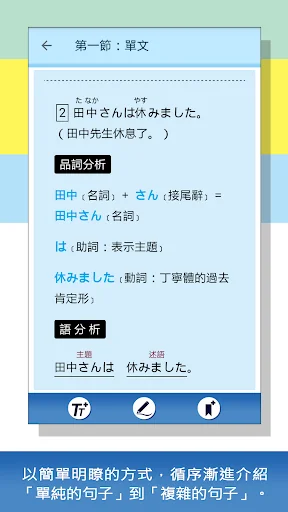
"Theory + Examples" pay equal attention to "Analysis of Japanese Structure"
Tips: The necessity and impact of [memorizing single words, distinguishing parts of speech, learning style, grammar, and particles]
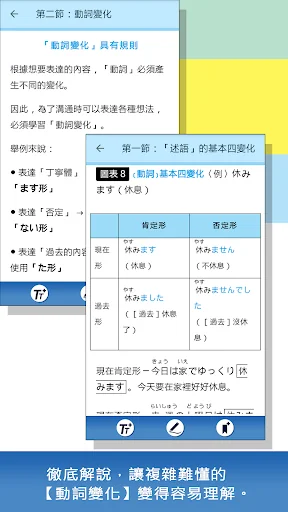
Decryption: Guidelines for self-study and improvement of [reading comprehension, listening comprehension, conversation, composition, verb conjugation]
Start from the basics, make good use of the tools in this book, answer your questions and continue to make progress!
When learning …
"Theory + Examples" pay equal attention to "Analysis of Japanese Structure"
Tips: The necessity and impact of [memorizing single words, distinguishing parts of speech, learning style, grammar, and particles]
Decryption: Guidelines for self-study and improvement of [reading comprehension, listening comprehension, conversation, composition, verb conjugation]
Start from the basics, make good use of the tools in this book, answer your questions and continue to make progress!
When learning Japanese, you no longer have to be stuck in "memorizing" or "getting used to" the "unexplained idioms" that may exist more or less in the language. Teacher Hitoshi Deguchi continues the teaching characteristic of "definitely explaining the reasons". Through "Japanese Structure Decrypted", he lets us know that "there are reasons for grammar and grammar" and "there are rules for sentence structure". He guides us to analyze the Japanese language step by step starting from the most basic structure. The whole picture.
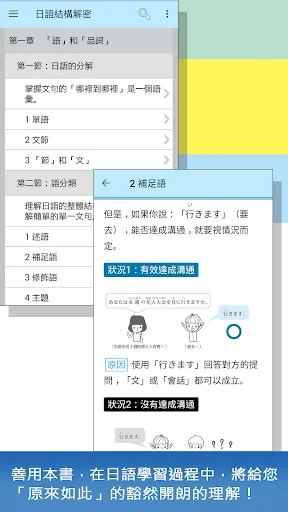
"Japanese Structure Decrypted" pays equal attention to "theory + examples + diagrams". It hopes that through easy-to-understand explanations, everyone can understand the Japanese structural rules contained in "simple sentences" or "complex sentences" and directly understand " What kind of language is Japanese?” After understanding the “reasons” and “rules”, you can draw inferences when you see similar content, accumulate and expand your learning results, and really make yourself “better the more you learn”!
●Content features
1. In-depth study of three major areas, specific learning objectives: Analyze the overall appearance of Japanese, and elaborate on "What kind of language is Japanese?"
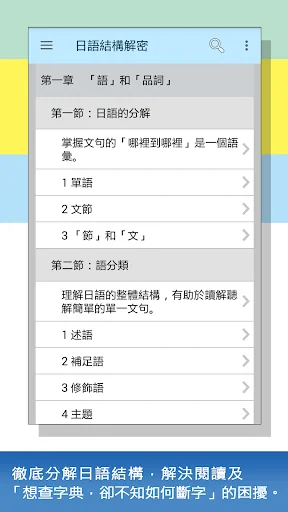
2. Layer-by-layer analysis of each field: Analyze layer by layer according to "Chapter" → "Section" → "Item" to explain the Japanese structure.
3. Pay equal attention to [theory + practical examples]: simple reasoning, matched with practical examples; echo the theory and understand immediately.
4. Diagramming [grasping the whole picture]: Collect concepts and clearly illustrate; rich in content, clear structure, and systematic learning.
● Learning function features
The learning function is complete, and you can make personalized settings according to your own learning pace and level:
1. [Provide the best reading mode]: Provide the best reading experience and can be used offline.
2. [Search]: Enter keywords to search for content.
3. [Bookmark]: Bookmark important learning content to facilitate repeated review in the future.
4. [Notes]: You can take notes during the learning process.
5. [Font]: You can adjust the font size according to your needs.
●Customer service contact: If you have any ideas or suggestions about the product, or encounter problems with use, you are welcome to contact us -
1. Customer service email: welcome@mail.soyong.com.tw
2. Customer service message board: https://www.mebook.com.tw/Android/SupportTC.asp
3. Customer service hotline: Please call 02-77210772 ext. 510 during working hours
We will serve you wholeheartedly.
● Privacy Policy: https://www.mebook.com.tw/common/normalservice.html
Business name: Soyong Corporation
Unified number: 16290238
Comparable Android apps
The five apps in Books & Reference with the closest revenue to 大家學標準日本語:日語結構解密. Click any to see its detail page.
Each forecast combines App Store rating, ratings count, monetisation model, pricing tier, IAP signals and ad-supported flag.
The base estimate is then multiplied by a per-category scaling factor learned from apps with founder-verified MRR.
Every number on this page comes from public APIs and bumetric's own snapshot history.
Full methodology covers input variables, accuracy bands per category and how we treat apps without comparable anchors.
See also the live data on 大家學標準日本語:日語結構解密's tracker page for current rating, reviews and snapshot timeline.
Building something similar? Get a free AI audit with $-revenue forecasts for every recommendation.

 Bangla To Arabic Translation
 Жрицы любви
 技能檢定-職業安全衛生管理乙級題庫
 French English ASV Bible
 Jain Aarti, Bhajan, Stotra and