What Bridges translation of Quran actually does (from store listing)
About Bridges’ translation of the ten Qira’at of the Holy Qur’an
Bridges’ translation was done with the aim of helping the non-Arabic reader in pondering the Qur’an (tadabbor). The translators focused not only on translating what God meant to say, but also on translating how He spoke.
Main features that make bridges translation unique:
1- It is the first translation which includes the ten Qira’at (modes of recitation). The main text is written in accordance with the most commonly used Qir…
About Bridges’ translation of the ten Qira’at of the Holy Qur’an
Bridges’ translation was done with the aim of helping the non-Arabic reader in pondering the Qur’an (tadabbor). The translators focused not only on translating what God meant to say, but also on translating how He spoke.
Main features that make bridges translation unique:
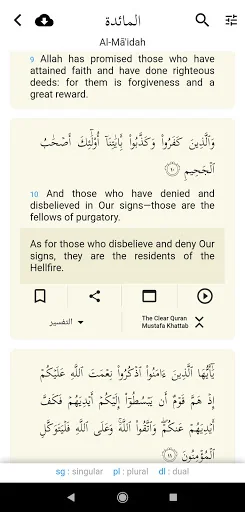
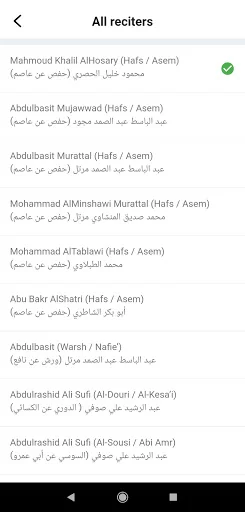
1- It is the first translation which includes the ten Qira’at (modes of recitation). The main text is written in accordance with the most commonly used Qira’a: that of Asem, narrated by Hafs. Variations from that are represented in footnotes. The translation presents around 30% of the variations of the Qira’at—those which affect the meaning and can therefore be demonstrated in translation. The rest are merely dialectical and cannot therefore be demonstrated in English.
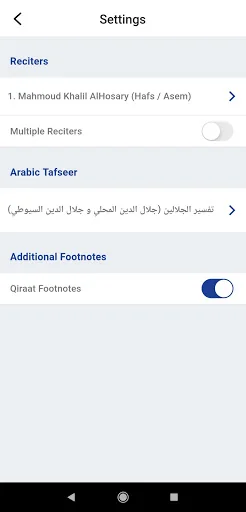
Terms that have footnotes related to the Qira’at’ are written in the text in red, and the related footnotes can be enabled or disabled from the settings.
2- It is the first translation that takes into consideration the Qur’anic phenomenon of grammatical shifts, whether in verb tenses, numbers or pronouns. These are a great source of pondering for the reader. Speaking about the Hereafter in past tense is a frequent feature of the Qur’an and this has been respected in this translation.
Terms that have footnotes related to grammatical shifts or other explanations are written in the text in blue.
3- To denote whether a pronoun like “you” or an imperative verb like “say” is plural, dual or singular, the translators did not impose their understanding on the reader by adding text between brackets like (O Prophet) to denote singular form, or (O mankind) to denote plural form. Rather, this distinction was achieved by adding a superscript after nouns, pronouns and imperative verbs. For example: youpl is used for a plural pronoun, yousg for a singular pronoun and youdl for a dual pronoun. Likewise, imperative verbs such as “say” are expressed as saypl for a plural verb, saysg for a singular verb and saydl for a dual verb. It must be noted that in the Qur’an most imperative verbs in the singular form are meant to address Prophet Muhammad (peace be upon him).
About Bridges Foundation
Bridges Foundation is an international organization specializing in introducing Islam to both Muslims and non-Muslims.
To get more information about Bridges’ activities or to contribute to its educational and Da’wa programs, please visit our website at www.bridges-foundation.org.
A large team worked tirelessly for more than three years on this translation and their effort is deeply appreciated.
Translation team members and linguists:
- Imam Fadel Soliman (team coordinator, translator, theology & Qira’at consultant)
- Dr. Hala Muhammad (translator)
- Dr. Adel Salahi (linguistic consultant)
- Dr. Sohaib Saeed (linguistic consultant)
- Ms Sally Epps (linguistic consultant)
- Dr. Mustafa Khattab (Qira’at reviewer)
- Imam Yusuf Wahb (Qira’at reviewer)
- Dr. Walaa’ Ramadan (editor)
References
Books of tafseer:
- Rouh Al-Ma’any by Al-Alousi
- At-Tahreer wal Tanweer by Ibn Ashour
- Al-Kashāf by Al-Zamakhshari
- Nazm Ad-Dorar by Al-Beqa’i
- Jame’ Al-Bayan by At-Tabari
- Al-Jame’ Le’Ahkam Al-Qur’an by Al-Qurtubi
- Mafatih Al-Ghayb, the grand tafseer by Ar-Razi
- Fat’h Al-Qadeer by Al-Shawkani
Books of Qira’at:
- The Ten Consecutive Qira’at from the Way of Al-Shatebeya and Ad-Dorrah by Sheikh Muhammad Korayem Rajeh
- The Tajweed Mus-haf with the ten Qira’at by Dr Ahmad Issa Al-Ma’sarawi
Comparable Android apps
The five apps in Books & Reference with the closest revenue to Bridges translation of Quran. Click any to see its detail page.
Each forecast combines App Store rating, ratings count, monetisation model, pricing tier, IAP signals and ad-supported flag.
The base estimate is then multiplied by a per-category scaling factor learned from apps with founder-verified MRR.
Every number on this page comes from public APIs and bumetric's own snapshot history.
Full methodology covers input variables, accuracy bands per category and how we treat apps without comparable anchors.
See also the live data on Bridges translation of Quran's tracker page for current rating, reviews and snapshot timeline.
Building something similar? Get a free AI audit with $-revenue forecasts for every recommendation.


 Tefilot SJ
 Tajik English Translate
 English Audiobook & Fairytales
 رواية أحببت ضابطة شرطة
 Physics and Chemistry