How much does Space Station Research Xplorer earn?
Android app
from NASA
· Education
ML forecast★ 4.3 · 728Free
~437/mo
ML revenue forecast.
Calibrated against 120891 apps in this category.
Confidence band
±15%
High — many comparable apps with verified data
At a glance
Earns 2.73× more than the category median (159/mo).
Ranks #11,970 of 120,891 in Education (top 9.9% by revenue).
Launched Oct 27, 2014 · last updated Mar 03, 2026.
What the app looks like
Live screenshots from the Play Store, captured by our snapshot worker. Tap any image to enlarge.
Space Station Research Xplorer's revenue trajectory
Forecast revenue from snapshot history. Last 1 months.
Where Space Station Research Xplorer sits in Education
Revenue distribution of 120891 comparable apps. Space Station Research Xplorer highlighted.
Space Station Research Xplorer vs comparable apps
Revenue trajectory side-by-side. Bold = Space Station Research Xplorer, ghosted = peers.
App spec
Version
26.2.4
Last update
Mar 03, 2026
Launched
Oct 27, 2014
Price
Free
Monetization
Free
What Space Station Research Xplorer actually does (from store listing)
Explore the diverse ecosystem of experiments being researched on the International Space Station – both completed and ongoing. Investigate the results and benefits of many of the experiments and find out why performing research in a microgravity environment is so important. The Space Station Research Explorer provides current information on ISS experiments, facilities and research results through video, photos, interactive media, and in-depth descriptions.
The Experiments section provides acc…
Explore the diverse ecosystem of experiments being researched on the International Space Station – both completed and ongoing. Investigate the results and benefits of many of the experiments and find out why performing research in a microgravity environment is so important. The Space Station Research Explorer provides current information on ISS experiments, facilities and research results through video, photos, interactive media, and in-depth descriptions.
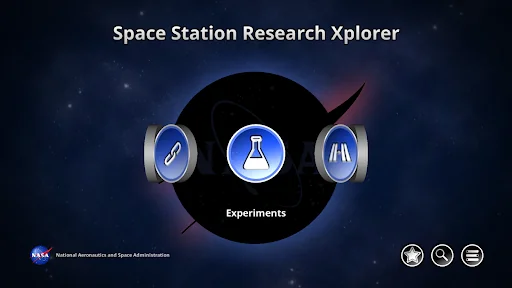
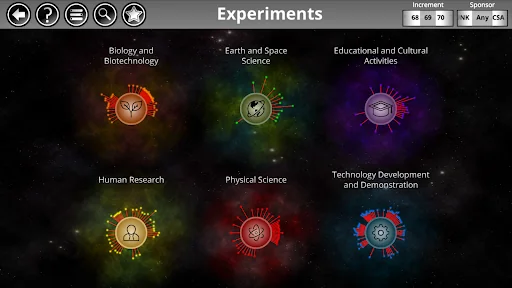
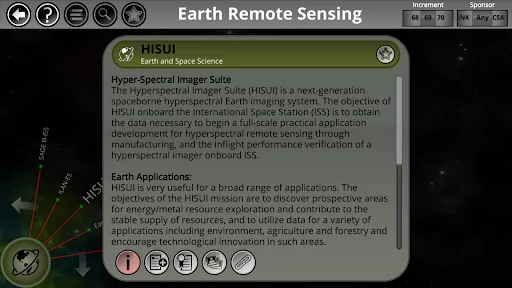
The Experiments section provides access to the six main experiment categories and their subcategories. Experiments are depicted as dots within the category system and the stems connecting the dots to the system depict the length of time the experiment spent on orbit. Users can drill down to see specific experiments within the categories and subcategories or search for a specific experiment or subject using the search option. Experiment descriptions consist of links, images, and publications if available. The Experiments section can be further narrowed by selecting a specific expedition and sponsor by using the dials at the top right of the screen. Experiments can be added to a favorites list for quick access.
The Lab Tour section provides an interior view of three of the station modules; Columbus, Kibo, and Destiny, and an exterior view of seven external facilities; ELC1-4, Columbus-EPF, JEM-EF and AMS. The module interiors can be navigated by dragging up and down to see different sides of the module and left and right to view any racks not shown on the screen. Tapping a rack gives a brief description of the rack and an experiment description if available. For the externals, the platform is shown and can be rotated and zoomed. Payloads on the external racks are labeled and the labels can be selected for more information.
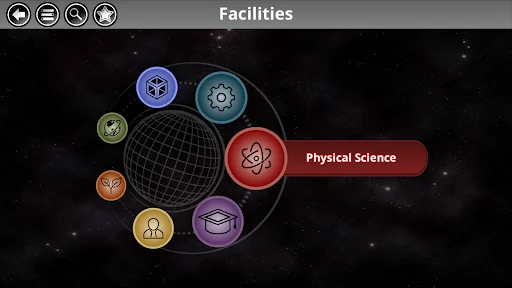
The Facilities section provides information on all of the facilities available on board the International Space Station that can be used to conduct experiments. The facilities are broken up into six categories: Physical Science, Human Research, Biology and Biotechnology, Earth and Space Science, Multipurpose, and Technology Development and Demonstration. These include facilities such as centrifuges, additive manufacturing facility and glove boxes.
The Benefits section provides information about the microgravity laboratory highlighting groundbreaking discoveries helping society, technologies tested for future space exploration, new scientific breakthroughs, and contributions to the growing low-Earth orbit (LEO) economy.
The Media section provides links to science-related videos.
The Links section is an index of space station research sites and NASA applications.
Comparable Android apps
The five apps in Education with the closest revenue to Space Station Research Xplorer. Click any to see its detail page.
Each forecast combines App Store rating, ratings count, monetisation model, pricing tier, IAP signals and ad-supported flag.
The base estimate is then multiplied by a per-category scaling factor learned from apps with founder-verified MRR.
Every number on this page comes from public APIs and bumetric's own snapshot history.
Full methodology covers input variables, accuracy bands per category and how we treat apps without comparable anchors.
See also the live data on Space Station Research Xplorer's tracker page for current rating, reviews and snapshot timeline.
Building something similar? Get a free AI audit with $-revenue forecasts for every recommendation.

 الثانية اعدادي دروس و تحديات
 Ayat ul Kursi
 Learn French - Beginners
 DYP Imtahan
 Objectives Physics for NEET