What Talmud Jerusalem actually does (from store listing)
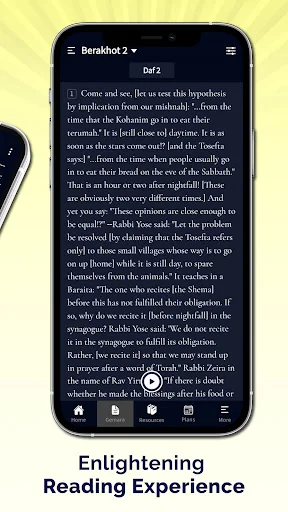
The Talmud Yerushalmi texts and Jewish commentaries are provided in Hebrew and English (some Sederem not translated yet to English).
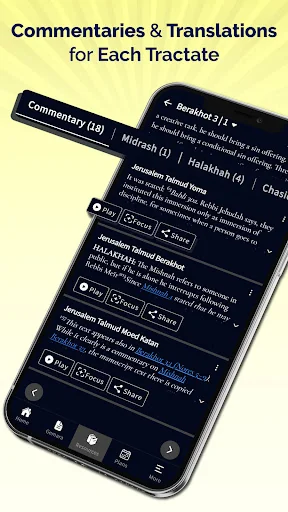
Clicking on the text directs to a page with commentaries, translations and more biblical sources.
The Jerusalem Talmud (Hebrew: תַּלְמוּד יְרוּשַׁלְמִי, Talmud Yerushalmi, often Yerushalmi for short), also known as the Palestinian Talmud or Talmuda de-Eretz Yisrael (Talmud of the Land of Israel), is a collection of Rabbinic notes on the second-century Jewish …
The Talmud Yerushalmi texts and Jewish commentaries are provided in Hebrew and English (some Sederem not translated yet to English).
Clicking on the text directs to a page with commentaries, translations and more biblical sources.
The Jerusalem Talmud (Hebrew: תַּלְמוּד יְרוּשַׁלְמִי, Talmud Yerushalmi, often Yerushalmi for short), also known as the Palestinian Talmud or Talmuda de-Eretz Yisrael (Talmud of the Land of Israel), is a collection of Rabbinic notes on the second-century Jewish oral tradition known as the Mishnah. Naming this version of the Talmud after the Land of Israel rather than Jerusalem is considered more accurate by some because, while the work was certainly composed in "the West" (as seen from Babylonia), i.e. in the Holy Land, it mainly originates from the Galilee rather than from Jerusalem in Judea, as no Jews lived in Jerusalem at this time.[1][2] The Jerusalem Talmud was compiled in the Land of Israel, then divided between the Byzantine provinces of Palaestina Prima and Palaestina Secunda, and was brought to an end sometime around 400.[citation needed] The Jerusalem Talmud predates its counterpart, the Babylonian Talmud (known in Hebrew as the Talmud Bavli), by about 200 years,[citation needed] and is written in both Hebrew and Jewish Palestinian Aramaic. (From Vikipedia)
Each forecast combines App Store rating, ratings count, monetisation model, pricing tier, IAP signals and ad-supported flag.
The base estimate is then multiplied by a per-category scaling factor learned from apps with founder-verified MRR.
Every number on this page comes from public APIs and bumetric's own snapshot history.
Full methodology covers input variables, accuracy bands per category and how we treat apps without comparable anchors.
See also the live data on Talmud Jerusalem's tracker page for current rating, reviews and snapshot timeline.
Building something similar? Get a free AI audit with $-revenue forecasts for every recommendation.




 Kürtçe-Türkçe Tercüman
 Pashto multilingual dictionari
 Ақын А.Байтурсынов
 Basel Mission Hymn Book
 Surah Tariq